Serving Redlands, CA and surrounding areas. (909) 488-7993
Redlands Masonry & Concrete provides retaining wall construction, concrete repair, and masonry work throughout Grand Terrace, CA. We have served the Inland Empire since 2017 and respond to every inquiry within one business day.
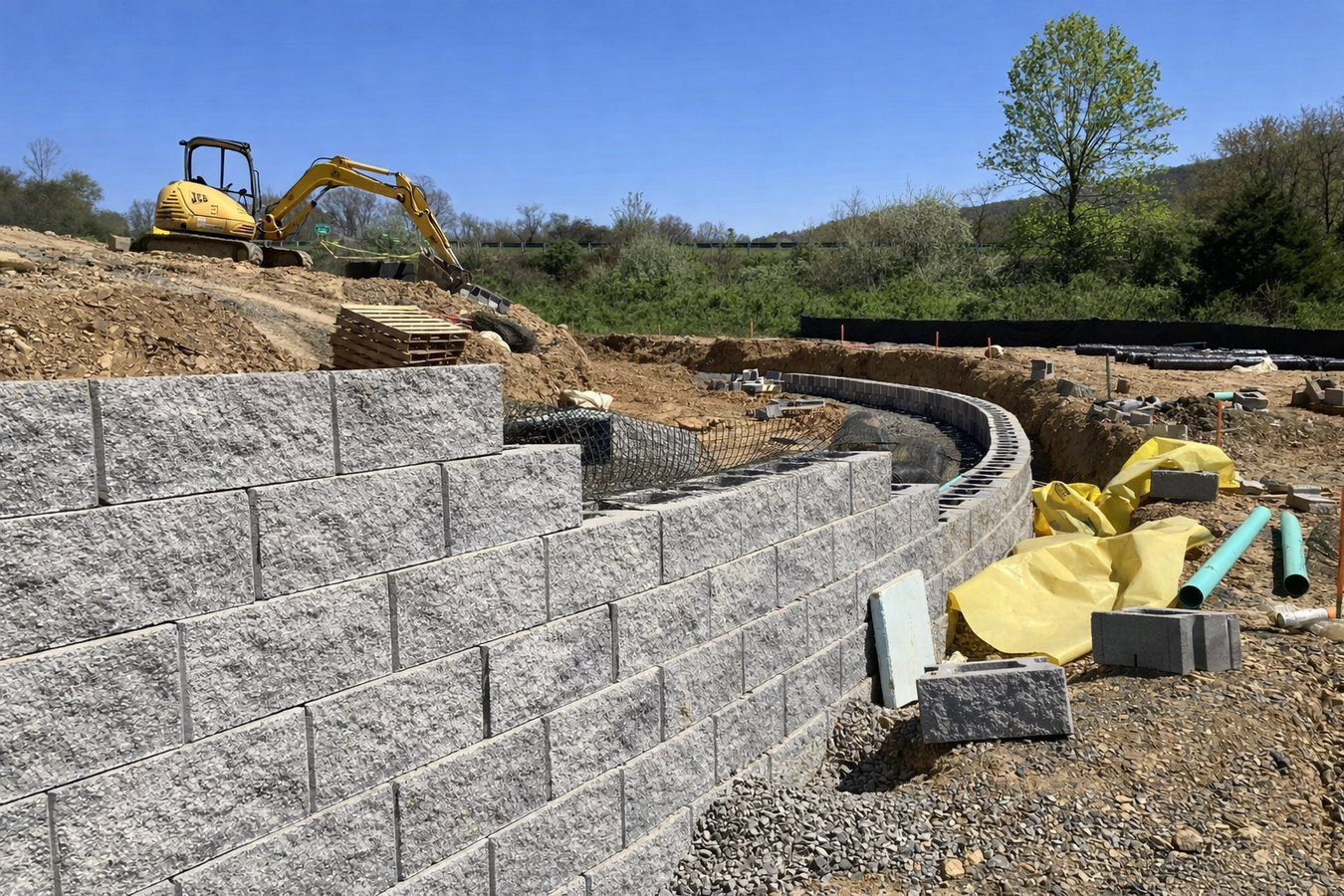
The sloped lots on the east side of Grand Terrace near Blue Mountain create real soil pressure and drainage challenges that flat suburban properties simply do not have. A properly engineered retaining wall with gravel drainage, correct footing depth, and steel reinforcement is what keeps hillside landscaping stable year after year. See our retaining wall construction service.
Block walls are standard property dividers on Grand Terrace's compact residential lots - most homes built from the 1960s onward have them. Block walls in this part of San Bernardino County need reinforced cores to handle both seismic activity and the soil expansion that comes with wet winters and dry summers.
Grand Terrace's housing stock is mostly from the 1960s through the 1990s - old enough that original slab foundations are showing the effects of decades of clay soil movement. Diagonal cracks at door corners and doors that no longer close squarely are common early signs that a foundation inspection makes sense.
Driveways on Grand Terrace properties that are 30 to 50 years old have typically seen enough heat cycles and soil movement to crack or sink in sections. Paver replacements are practical in this climate because individual units can be re-leveled when the ground shifts rather than requiring a full slab tear-out.
Block fences and brick features on older Grand Terrace homes often have mortar joints that have degraded over decades of Inland Empire heat. Crumbling mortar lets water into the wall's core, which accelerates deterioration and leads to full block failures faster than most homeowners expect.
Front walkways on Grand Terrace's modest lots are some of the most visible features of a property. A cracked or sunken walkway is one of the first things visitors notice. Rebuilding in concrete or pavers restores safety and curb appeal, which is especially noticeable on lots where the walkway and driveway together are most of the front yard.
Grand Terrace is a compact city with a tight housing market, and most of its homes were built between the 1960s and the 1990s. Ranch-style single-family homes dominate the city, and the majority of those properties have concrete driveways, walkways, and block wall fencing that are now 30 to 60 years old. At that age, the concrete has been through enough heat cycles, frost events, and soil movement to show meaningful wear - cracking, surface deterioration, and settled sections are common on properties throughout the city. The clay soils that run beneath much of Grand Terrace expand when wet and shrink when dry, and that annual cycle is one of the main drivers of cracked slabs and shifting flatwork in this part of San Bernardino County.
The eastern edge of Grand Terrace rises toward the Box Springs and Blue Mountain areas, giving those neighborhoods a hillside character that flat Inland Empire suburbs do not have. Sloped lots in that part of the city often have retaining walls, and those walls - many built in the same postwar decades as the homes - are at or past the end of their service life. An undersized retaining wall without adequate drainage behind it cannot hold back the pressure that builds up after a wet winter in this area. Summer temperatures in Grand Terrace regularly push above 100 degrees, which accelerates mortar degradation on block walls and chimneys and causes concrete to expand and contract more aggressively than in cooler climates.
Our crew works throughout Grand Terrace regularly, and we understand the local conditions that affect masonry contractor work here. Structural work that requires permits in this city goes through the City of Grand Terrace offices on Barton Road, and we know how the local permitting process works so we can give homeowners an accurate timeline from the start.
We are familiar with the two distinct parts of Grand Terrace. The flatter streets near Barton Road and Richard Rollins Park are typical Inland Empire ranch-home neighborhoods with standard lot grades and mostly flat concrete challenges. The hillside neighborhoods on the east side, closer to Blue Mountain, are a different job entirely - sloped terrain, drainage concerns, and retaining walls that need to be engineered for the actual soil and load conditions on each specific lot. We approach those two parts of the city differently because they require different solutions.
We also work regularly in neighboring communities served on the same routes. Homeowners in Colton to the north are on the same schedule, and we know the shared valley floor conditions that affect both cities. The I-215 runs right along Grand Terrace's western edge and is how our crew accesses the city from both directions.
We respond within one business day. Telling us what you are seeing - a leaning retaining wall, cracked driveway, or block wall damage - helps us bring the right assessment tools to your property.
We come to your Grand Terrace property, assess the actual conditions including soil, slope, and drainage, and give you a written estimate at no charge. For hillside lots, we also note drainage requirements that affect long-term performance - a detail that saves money later.
If your project requires a city permit, we handle the application and coordinate the timeline around the approval window. You do not need to manage the permit process yourself.
We complete the project on the agreed schedule, clean up the work area, and walk you through what was done. If any inspection is required, we coordinate that too.
Serving Grand Terrace homeowners since 2017. No charge for estimates. We respond within one business day.
(909) 488-7993Grand Terrace is a small city in San Bernardino County with a population of around 12,000 people, tucked into just under 3.5 square miles between Colton to the north, the I-215 to the west, and the base of the Blue Mountain area to the east. It has the character of a close-knit neighborhood rather than a sprawling suburb - most residents know their neighbors, and home ownership rates are high. You can read more about the city's history and geography on the Grand Terrace Wikipedia page. Barton Road is the city's main commercial corridor, lined with the shops, restaurants, and services that residents use daily, and Richard Rollins Park nearby is the community's main outdoor gathering spot.
The housing stock is predominantly single-family detached homes built between the 1960s and 1990s - ranch-style and traditional single-story layouts with stucco exteriors, attached garages, and modest lots. Homes on the flatter western streets near the freeway have fairly standard lot grades, while properties on the hillside edges of the east side of town sit on more varied terrain with sloped lots and views of the surrounding valley. Grand Terrace borders Colton directly to the north and is a short drive from Loma Linda, and homeowners in all three communities deal with similar Inland Empire soil and climate conditions.
Restore structural integrity and stop foundation damage before it spreads.
Learn MoreControl erosion and grade changes with a durable retaining wall.
Learn MoreInstall a beautiful masonry fireplace that becomes a home centerpiece.
Learn MoreBuild strong, long-lasting walls using quality concrete block masonry.
Learn MoreSet a solid foundation with precisely installed concrete block walls.
Learn MoreCreate a custom outdoor kitchen built to last through every season.
Learn MoreConstruct classic brick walls for boundaries, privacy, or decoration.
Learn MoreCall or submit your request today. We serve Grand Terrace homeowners and respond within one business day.